Homework for Chapter 8 - The Atmosphere in Motion: Air Pressure, Forces, and Winds
SHOW ALL WORK , CIRCLE THE CORRECT ANSWER, PLEASE BE NEAT AND STAPLE YOUR HOMEWORK!
ALSO, PLEASE USE A SPREADSHEET FOR ALL GRAPHS
Follow the Problem solving steps discussed in class
1. On a given day, you observed that the wind is 75 kts here at LSC at 500 mb. Further, you also observe that the isobars are straight and that the flow is from west to east.
a. Assuming that the flow is geostrophic, what is the magnitude of the pressure gradient force producing the observed wind?
b. What are the directions of the pressure gradient and coriolis forces necessary to produce the observed flow?
c. If the flow on a given day at Montevideo, Uruguay is 75 kts at 500 mb, draw a diagram showing the direction of the pressure gradient and coriolis forces and the resultant wind direction assuming that the flow is geostrophic.
2. The flow within a tornado is due to the combination of the pressure gradient and centrifugal forces. In other words, for a tornado
pressure gradient force + centrifugal force = 0
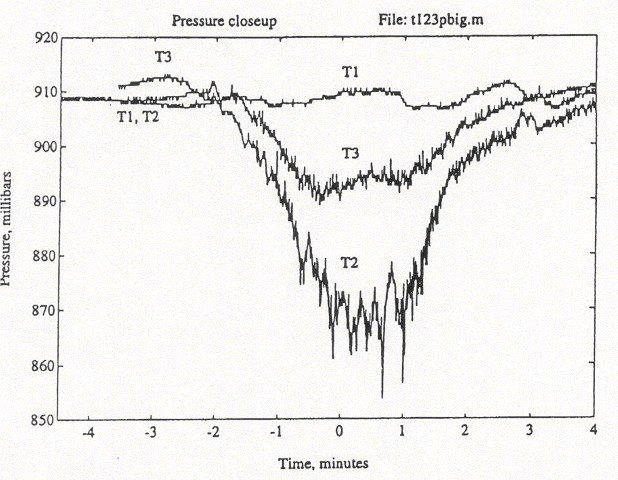
The data below is a pressure trace near a large tornado. Time = 0 is when the tornado was closest to the weather station. Use this data (T2) to estimate the tornado winds. Assume the tornado diameter is 1 km. You can assume that the air density is 1 kg m-3.
From Winn et al., Journal of Geophysical Research-D, Sept. 27, 1999, Figure 13, page 22077.
3. Given a 40 knot geostrophic northwesterly wind at 500 mb, draw a diagram showing the orientation of the height lines necessary to create this wind. Also draw in the directions and relative magnitudes of all forces acting on this air parcel.
4. Now consider a 20 knot southeasterly wind at the surface. Draw a diagram illustrating the orientation of the isobars necessary to create this wind and also draw in the direction and relative magnitudes of all forces acting on this parcel of air.
EXTRA CREDIT: With the aid of a diagram and using the concepts discussed in this chapter, explain why the jet stream is located over a frontal boundary.