Homework for Chapter 7 - Stability and Cloud Development


Questions 1 and 2 will be turned in for a grade. Questions 3-9 will be discussed by the discussion groups in class so please look them over before the discussion session.

SHOW ALL WORK , CIRCLE THE CORRECT ANSWER, PLEASE BE NEAT AND STAPLE YOUR HOMEWORK!

Follow the Problem solving steps discussed in class


1. Given the following surface conditions:

a.  T = 30 degrees C, Td = 19 degrees C

b.  T = 35 degrees C, Td = 14 degrees C

c.  T = 34 degrees C, Td = 9 degrees C

d.  T = 29 degrees C, Td = 7 degrees C

e.  T = 32 degrees C, Td = 6 degrees C

a.  For which conditions would one see the highest cloud base?  What would the cloud base height be?  What is the relative humidity for these conditions?

b. For which conditions would one see the lowest cloud base?  What would the cloud base height be?  What is the relative humidity for these conditions?


2. Plot the following sounding. Label on your graph the locations of 1) absolutely stable, 2)absolutely unstable, and 3) conditionally unstable layers.  Indicate the height of the top and bottom of these layers.  Where would cloud base and top be if a surface parcel has a temperature of 40 ºC and a dew point of 24 ºC?

Height (meters) Temperature ( degrees Celsius)
0 40
1000 28
2000 20
3000 12
4000 4
5000 15
6000 6
7000 -4
8000 -8
9000 -5
10000 2

3. What direction would the wind be coming from for a rain shadow to be observed here at LSC due to flow over the White Mountains?

4. Are the bases on convective clouds generally higher during the day or the night? Explain. If the vapor pressure at a given location remains the same during the day, when will cloud base be highest on that day.

5. How is it possible for a layer of air to be convectively unstable and absolutely stable at the same time?

6. Use the summertime map of vapor pressure in Ch5 to help you explain why the bases of cumulus clouds, which form from rising thermals during the summer, increase in height above the surface as you move due west of a line that runs north-south through central Kansas.

7. If the height of a cumulus cloud is 1000m above the surface, and the dew point as the earth's surface beneath the cloud is 20 ºC, determine the air temperature at the earth's surface beneath the cloud.

8. Suppose the air pressure outside a conventional jet airliner flying at an altitude of 10 km is 250 mb. Further, supose the air inside the aircraft is pressurized to 1000mb. If the outside air temperature is -50 ºC, what would be the temperature of this air if brought inside the aircraft and compressed at the dry adiabatic rate to a pressure of 1000mb (assume that a pressure of 1000mb is equivalent to an altitude of 0 m).

9. Pull up the latest ALB sounding. Find the location of one absolutely stable, conditionally unstable, and absolutely unstable layer. Indicate the pressure of the base and top of these layers on the blackboard.

10.  Using the interactive tool on this page, under what atmospheric conditions will cloud base be close the the ground?  Under what conditions will cloud base be relatively high?


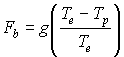
EXTRA CREDIT: The buoyancy force that a parcel of air experiences is created when a density difference between the environmental air and the parcel exists. Per unit mass, the buoyancy force may be expressed as:

where g is the acceleration due to gravity, Te and Tp are the environmental and parcel temperatures, respectively. Show that the buoyancy force is positive (directed upward) when the density of the parcel is less than the density of the environment. (HINT: Use the ideal gas law)