
Homework for Chapter 5 - Condensation: Dew, Fog, and Clouds
SHOW ALL WORK , CIRCLE THE CORRECT ANSWER, PLEASE BE NEAT AND STAPLE YOUR HOMEWORK!
ALSO, PLEASE USE A SPREADSHEET FOR ALL GRAPHS
Follow the Problem solving steps discussed in class
1. Cloud and rain drops are pulled (accelerated) to the ground by gravity. The equilibrium velocity resulting from a balance between gravity and frictional drag is called the terminal velocity. For cloud droplets, the terminal velocity can be expressed as:
where k1 = -1.19x10⁸ m-1 s-1. The negative sign indicates that the drops are falling. Given cloud droplets 10 microns in size, how strong would an updraft have to be to keep the droplets suspended in the cloud?
2. A third method for bringing air to saturation is by mixing two air parcels together. This method is responsible for why you often can see your breath on a cold morning.
Suppose that an air parcel coming from your mouth has a temperature of 30 ºC and a vapor pressure of 34 hPa while an air parcel outside of your mouth has a temperature of -4 ºC and a vapor pressure of 0.2 hPa. If the mass of the parcel in your mouth is 0.5 kg and the parcel outside your mouth has a mass of 1.0 kg, will the mixture of the two parcels be saturated? Will you be able to see your breath on this day?
3. On each of three different days over the Gulf of Mexico, the air has the following temperature and dew point:
- T=40 ºC, Td=5 ºC
- T=40 ºC, Td=35 ºC
- T=10 ºC, Td=-5 ºC
On which days will upslope fog form at Denver, CO? Show work.
4. If evaporation of water vapor from the ground to low levels in the atmosphere occurs at a rate such that the dew point temperature of a parcel of air increases by .2 ºC per hour and it takes 1.5 days for a parcel with T=25 ºC and Td=0 ºC to travel from Illinois (elevation=1000') to Denver (elevation=5280'), will fog form in Denver? Show work.
EXTRA CREDIT: For satellites in near circular orbits, the pull by the earth's gravity Fg is balanced by the centrifugal force Fc on the satellite:
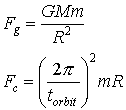
where R is the distance between the center of the earth and the satellite, m is the mass of the satellite, M is the mass of the earth (5.98x1024kg) and G is the gravitational constant (6.67x10⁻¹¹ Nm2kg-2). At what altitude above the earth's surface must a geostationary satellite be placed?